Sunday, February 27, 2011

Scarlet Needs a Family

          It is once again that time of the month when I make my visit to the Delaware County SPCA in search of a dog that needs help in finding a home.  I walked in and was greeted by Justina, and she informed me that she had a dog that was in need of some help finding a home.  They had her in the back office and I was told her name was Scarlet.


          Justina lead me back to the office where I saw Scarlet laying on a makeshift doggie bed they had set up for her.  Scarlet saw me come in and immediately bounced over to where I was standing and very cheerfully and not so subtly made it known she wanted some love.  I stooped down and started to pet her, she was such a happy dog.  I still cannot understand why they were having such a hard time adopting her out.  Scarlet is a pit bull, and that may be part of the reason, but anyone who spends more than five seconds with this dog would know what a great find she was.  It is such a shame pit bulls have a bad reputation. 


          Scarlet was a stray as well as pregnant when she was found.  She was brought to the Delco SPCA on December 12th.   She had her pups not to long after she was brought in.  Of course there was no problem finding homes for her pups.  Everyone loves a puppy.  Scarlet remains, still in need of a happy home.  The folks down at the SPCA let me know that Scarlet loves children.  I was told that she gets very happy and playful whenever a child is near.  She would make a great family dog.  I even considered taking her myself, but my hands are full with the two dogs I have.  I have put an extra effort out in trying to find Scarlet a home.  I have asked friends and family to put the word out.  If you are reading this and you are thinking of adopting a dog, you cannot do much better that to adopt Scarlet. 


          Since Scarlet has been there for a while the adoption fee has been reduced quite a bit in order to help her find a home.  She would be great for any family with children.   Children should be over the age of 8.  She is not so good with cats however.  If you have a dog, you can bring your dog there so they can meet and see if Scarlet would be a good fit.   Her ID number is 38841, if you are interested you can feel free to drop by and see this loveable dog for yourself.  If you have any questions feel free to call them at 610-566-1370.  You can also check out their web site http://delcospca.org/.  I really hope one of you out there can find it in your heart to give this truly deserving dog a home, and help to keep her healthy and happy.

Nick C
DoggieDiaries4u@gmail.com

Monday, February 14, 2011

Home Cooked Food for Your Dog

          I am happy to say that we have been making our own dog food for a few months now.  I have written on this topic before and if you will recall, the last time I wrote about dog food it was because Jasmine (our black lab) got very sick when we transitioned her from the homemade food back to her dry dog food.  Since that time, Jasmine and Frankie (our Siberian husky) have been enjoying a steady diet of homemade food.
          Jasmine has lost a lot of weight.  It’s funny, but we have been trying to get her to lose weight for a few years now, and nothing seemed to be working.  We would exercise her daily, we cut back on the amount of food we would feed her three times until she was eating a cup in the morning and a cup in the evening.  We had no idea her weight loss would be the result of homemade food.  She is now 20lbs lighter.  She lost the weight so fast it gave us pause and we took her to the vet.  The vet was shocked and did a full work up on her, she is in perfect health.  We are now feeding her 2 cups of homemade food in the morning and 2 cups of homemade food in the evening.  She is slim, her coat is so much softer, and she has so much more energy.  She is a completely different dog.  Frankie has lost a few pounds as well, though she was not overweight to begin with.   The big difference with Frankie is her coat.  Huskies have a very thick coat and they tend to shed… a lot.  Since we have been giving her the home made food she has not been shedding nearly as much and her coat feels like incredibly soft.
          You might think making dog food for your dog will be labor intensive.  I won’t lie to you, at first it was.  We now have a routine and we make the food once a week, sometimes we will make a batch that will last 2 weeks.  It is not all that hard to do, it takes about 30 minutes to put together, and a few hours of cooking time, but that is as easy as boiling some chicken.  There is no need to worry about spices or seasonings, dogs don’t need that stuff.  In fact it’s better for the dog if you don’t season the food.  Too much salt is a bad thing for a dog.  The cost is a little more than buying the dry dog food we used to, but honestly the difference is not that much.  The benefits we see from the homemade food outweigh the little extra cost.  I used to think people that feed their dogs homemade food were spoiling their dogs.  It took Jasmine getting sick for me to see how much better homemade food is for my dogs.
          I am giving you the recipe we use for our dogs below.  Try it for a month and see what happens.  It can’t hurt to try; right?

This recipe will feed two medium dogs for about a week.
You will need.
Chicken legs (2 family packs approximately 32 legs)
8 cups of medium or long grain rice
2 big family sized packages of frozen vegetables (carrots, broccoli, and cauliflower)

To cook the rice, put 8 cups of rice into a large stock pot add 16 cups of water, bring to a boil, then reduce to a simmer and cook until the rice has absorbed all the water
For the Chicken legs you can boil them for a few hours or until the meat is easy to remove from the bone.  You can also put them in a crock pot in the morning, when you come home they will be ready.  Place on a cookie sheet to cool.  Once cool remove the meat from the bone, do not forget to get the small bone, it will come off with the meat, do not let that get into the food, it could harm your dog.  Make sure you save the water you cooked the chicken in.
Boil the vegies until done.
Once the chicken is deboned, the rice and veggies are cooked you can combine it all, mix in a little of the chicken stock you saved from cooking those chicken legs until it is a nice consistency.  Store it in the fridge and use that to feed your dogs. 
You should warm the food to just about room temperature before feeding.  You can do this by putting the food in the microwave for a few minutes.  Make sure you test the food before you give it to your dog.  You don’t want to accidently burn them, and microwaves are famous for creating hot and cold spots. 
          I hope the recipe is clear.  If you have any questions feel free to e-mail me at doggiediaries4u@gmail.com.  If you try this for a month I am betting your furry family members will love you for it, and it will make the all the more happy and healthy.

Nick C
DoggieDiares4u@gmail.com

Tuesday, February 8, 2011

Dog Flu H3N8 Update

          After posting this article, our friends at the local SPCA contacted me to inform me there is a vaccine for this strain of flu (H3N8).  The Delaware County SPCA has vaccinated all there dogs as of the new year, and they are offering the shot and boosters to the public for a small fee.  It is good to know there is a vaccine available for this flu.  So get your furry family member vaccinated, it will help to keep them healthy and happy.

Friday, February 4, 2011

Dog Flu H3N8

          Last week we took Jasmine to the vet.  She had lost so much weight with the home made dog food we felt a trip to the vet was in order.  We got some very good news.  It turns out that Jasmine is now at her optimal weight all her tests came back negative and the vet is thrilled to see her doing so well.  While I was waiting to pay the bill I came across a pamphlet about the dog flu.  I asked one of the nearby vet techs if the dog flu was a problem in our area.  She told me that it was in fact a very serious problem in Pennsylvania.

          The dog flu is actually a subtype of the type A influenza virus and is known specifically as H3N8.  It is highly contagious, and this virus causes acute respiratory infection.  While this in its self is usually not life threatening, it can cause pneumonia.  If pneumonia develops due to the flu virus, it can be life threatening.  This is not the norm however and most dogs will overcome the illness in 14 to 21 days.
          The dog flu is often times mistaken for kennel cough because the symptoms are very similar.  Some of the things to look out for are a runny nose, low grade fever, listlessness, coughing.  If your dog has these symptoms, a trip to the vet is in order.  If your dog does have the flu, he or she will probably recommend that the dog stay with them so the proper care can be given.  Though this flu is highly contagious, and is not much fun for any dog unlucky enough to catch this flu.  The H3N8 is usually not life threatening.  In fact it is the secondary complications that can become life threatening, and the chances of that are very small.  If taken to the vet and given proper care most dogs will get over this illness in a week or two.
          If your dog spends any time around other dogs, in a dog park for example, do not let your dog near any dog that is coughing or has any one of the symptoms listed above.  If your dog comes into contact with any dog that has this flu, your dog will catch it.  The best thing you can do to avoid this is to be observant, keep on the lookout for other sick dogs in places where your dog socializes with other dogs.  If you do this, and take your dog to the vet at the first sign of any illness your furry family member will continue to live a long and happy life.
          Thank you for reading; I hope the information in this article will help keep your furry family members healthy and happy for years to come.
Nick C
DoggieDiaries4u@gmail.com

Monday, January 24, 2011

To Harness or to Collar?

          As I was out and about yesterday, driving around doing errands, I saw a lot of people walking their dogs. The last time I saw this it inspired me to do an article on how to properly walk your dog. This was no different. I saw four or five people being walked by their dogs, this annoys me as it always does, but this time I took note of what the dogs had on. One had on a choker collar, it was a black lab, and this lab was pulling his owner down the road with all his might, gagging and hacking the entire way. I saw a yellow lab being walked with an interesting collar, it was a training collar. It looked like a standard collar except there was extension that lead toward the nose with a loop that went around the dogs nose.  Every time the dog tried to pull, the loop around the dogs nose would lead the dog to the left or the right, thus making the dog turn instead of pulling.  The dog would stop and try to correct its course, this seemed a very effective way to stop a dog from pulling. I am considering doing a review on this kind of collar. I also saw a boxer in a harness. This dog was trying to pull but was not having much luck. I guess that is better than dragging its owner down the street, but it was still pulling. Lastly I saw a couple of people using standard collars and they were being pulled around the walk way. Only one dog, a black lab mix was trained to walk properly. I was very glad to see this.
          I guess the big question would be... which is better, collar or harness? That answer is not as straight forward as you might think. If you have a well trained dog, that stays at your side when you walk, you can really use anything, a collar would be the most convenient for this type of dog. However if you have a dog that is a puller, like a husky, they can be tough to train. Not impossible just tough. A husky sees something sparkly and they are off to chase down their latest adventure. For this kind of dog a harness might be better. Even if this type of dog is well trained it may still try to dash off and pull you along. Pulling is in their blood, and because of this a harness will help you gain better control over a dog like this quickly. It will also prevent any throat injury that so often happens when a dog pulls while wearing a collar. If you are training your dog still, a training collar may be good, though I hesitate to recommend it because I have never used one.
          Both the standard collar and the harness have their pros and cons. The collar is simple, every dog should have a collar in order to display their licences, tags, and vaccination tags. You don't have to remove the collar very often. It is good with any dog that has been trained to walk with its owner properly. The down side of collars are few, but those few are big. For instance, if your dog pulls, all kinds of injuries to the dogs throat, neck and back can occur. If the dog is off leash, the collar can get caught on all manner of things from tree branches, bushes, and it can even get stuck in the cracks of deck planks. If you are going to use the collar to walk your dog, for your dogs sake, make sure they are trained to walk properly.
          The harness is a great tool, it gives you better control over your dog if it tries to pull away, limits the chance of injury to the throat neck and back of your dog. On the down side, it must be put on your dog before every walk and it can be complicated, depending on the harness you have. The harness must be removed after every walk, and the harness should be adjusted to fit your dog properly. If the harness is to tight it will be very uncomfortable for your dog, it may even be painful if it is adjusted to small for your dogs frame. The harness definitely has its place, and as I said it is a great tool to help you keep control of a dog that pulls. I still think the best way to keep control of your dog is to train it properly.
          As for all the other types of collars out there that I think I need to talk about. Choke collars, pincher collars, shock collars, and any other collar or device that causes discomfort or pain for your dog should not be purchased. There is no need for things like this. With a little research you can learn how to train your dog to do just about anything. There is no need to hurt your dog. Choke collars are the only exception to this, but they must be used properly. If you don't know what a choke collar is used for, or you don't know how to use one, don't. We are trying to avoid causing any harm or discomfort to our furry family members, and by not using devises that will make them uncomfortable or harm them, no matter how slightly, it will go a long way to keeping your furry family members healthy and happy.
Nick C

Monday, January 17, 2011

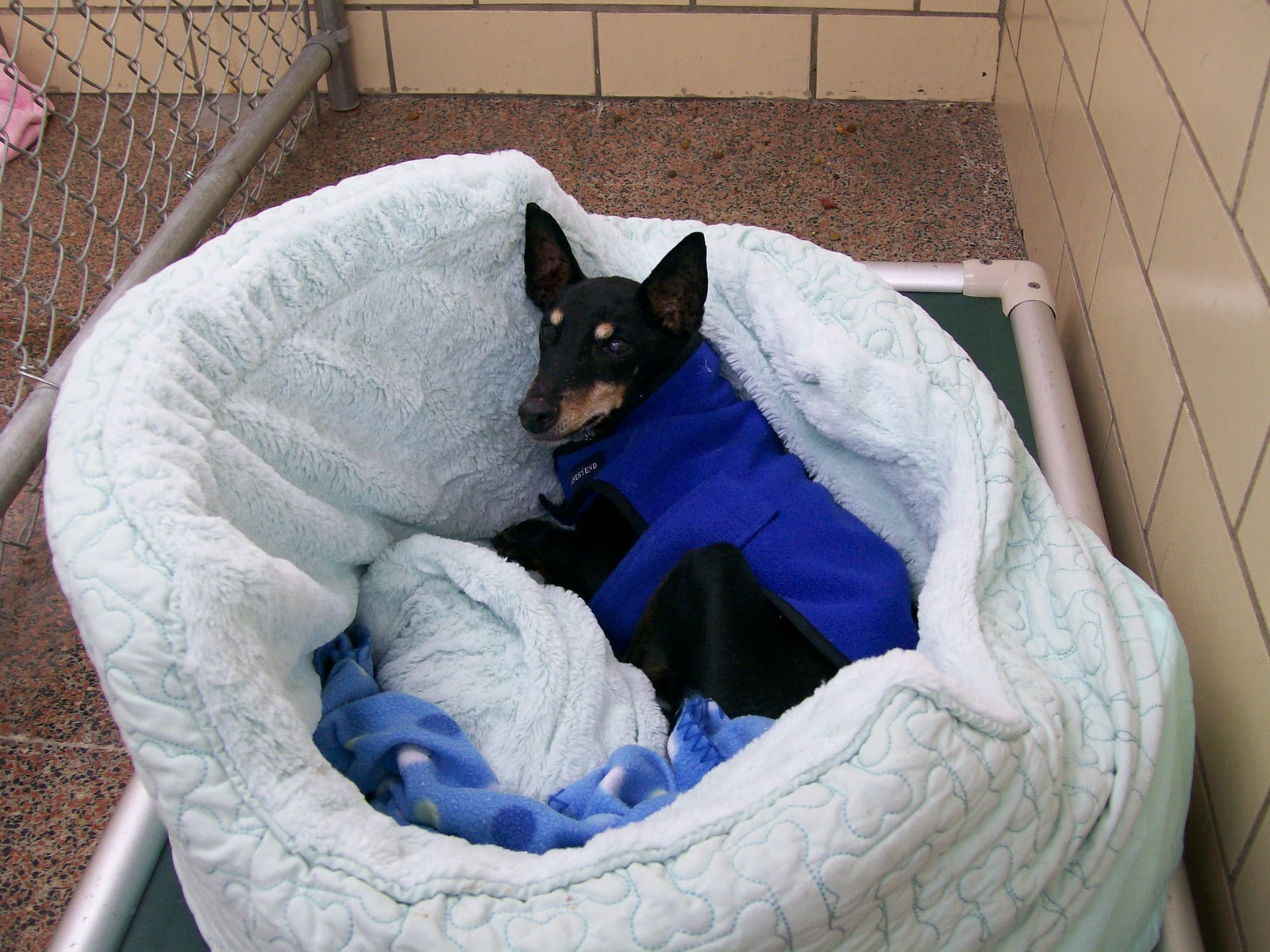
Monkey Needs A Home

          I have decided to begin a new page here at DoggieDiaries4U. After writing the article on the Delaware County SPCA, entitled Help Stop Abuse, Rescue A Dog, I found myself thinking of all the dogs there that are in need of a loving home. I thought this blog would be a great way to help find some well deserving dogs a good home. I am going to feature a new dog once a month. If you are thinking of getting a dog, there is no better place to start your search than at the Delaware County SPCA.

          The Dog we are featuring today is Monkey. He is a miniature pinscher, his ID# is 39303. He is an older dog that has some special needs. He has no teeth so wet dog food is a must for this little guy. He has been at the shelter for over a month now. I can tell you personally after visiting this guy he has a lot of love to give.

          After speaking with Justina, at the SPCA facility, about some of their special needs dog she told me that they had special programs for dogs like the one that is being featured here, as well as for seniors. I asked if she could send along the information on these programs, she did and I have posted below the programs she sent along. Thanks for the information Justina!


Seniors Saving Seniors Program:
People 55+ years old can adopt any cat approximately 5 years or older for only $25.50, and dog 5 years or older for $55.50. They will also get a certificate for a free wellness check and vaccines for the following year.

Special Needs Support Program:
In effort to keep pets in their homes and not have them turned over if families cannot afford medication or food, if people that have pets or adopt a pet that needs regular medicines or special food, we can purchase the medicine or food through our vet here at the shelter to save them a significant amount of money.

Monkey would apply to both!


          If you find yourself thinking about giving Monkey a loving home please contact the SPCA at 610-566-1370. They also have a great website where you can see all the animals up for adoption at http://delcospca.org/. Don't forget to give Monkeys ID Number 39303.

          Thank you for reading, I hope someone out there can give Monkey a loving home where he will be kept healthy and happy for years to come.

Nick C
DoggieDiaries4U@gmail.com

Wednesday, December 29, 2010

Puppies Need Care

          Puppies, puppies, puppies, everyone loves puppies.  Soft, cuddly, adorable puppies.  They melt your heart with a look, they make even the grumpiest smile, who can resist a puppy.  All of that is true, but love is easy when it comes to puppies, it’s the care part that can be difficult.  Some of you may be thinking of getting a puppy, or have found yourself on the receiving end of a gift puppy.  After all the ooos and ahs, are over, and the play time draws to a close, the questions start to set in.  What does a puppy need?  What kind of food?  What kind of vaccinations?  What do I do with the puppy when I go to sleep?  And many more questions I am sure.  The goal of this article is to help you with some of those questions.  If you don't find the answer you are looking for here, feel free to e-mail me and I will do my best to get your question answered.

          First you should know what to feed your puppy, and how often.  Puppies love to eat, and that is good.  You should feed your puppy as often as it wants to eat.  Puppies grow fast, and they need all the food they can get to ensure a healthy start to their life.  You can feed them like this until they are about 16 weeks old, at that point you need to be sure not to over feed them. As far as what you should feed your new puppy, you can feed them dry food formulated for puppies, you can feed them wet food for puppies, or a combination of the two, and if you are truly adventurous you can try your hand at making your own dog food.  Dogs vary from breed to breed when it comes to chow time.  You should check with your vet to ensure you have a good feel for how much your dog should be eating.  When you first bring a puppy home it may have some digestion problems that will cause it to vomit or have diarrhea (I know, who said puppies were cute all the time).  This is usually caused by a change in diet.  If this occurs, you may want to stop feeding your new bundle of fur for a few hours.  When you do feed your puppy again, feed it boiled chicken and rice.  This has always worked for me.  Even in older dogs, rice and chicken will help stop the vomiting and ease the diarrhea.  That being said, if the problem continues, or your puppy does not seem to want to eat, you should get it to the vet as soon as possible.

          Vaccines are a very important step in your puppy’s life.  There is one vaccination that is required by law here in Pennsylvania, you should check your local laws for your area, and that is a rabies vaccination.  I can not stress how important this is.  Rabies is a horrible disease, and having your dog vaccinated and keeping up with the booster shots is a must.  Not just because it’s the law, but because it protects your dog and everyone else from possibly contracting rabies.  Your puppy’s first rabies vaccination should be given at 13 weeks, and then again one year after that, then every 3 years.  Distemper is also a very important vaccine, and is required by law in some areas, distemper (Duramune, DHPP) can be given at 6 weeks, with 4 boosters, the last booster should be good for 1 year, and then every three years after that.  These next vaccinations are not usually required by law, but I would suggest you get them anyway.  They will ensure your puppy stays healthy for many years to come.  Lime, especially in areas where deer ticks are prevalent, should be given at 9 weeks, with 2 boosters, then once a year.  Lepto can also be given at 9 weeks with 2 boosters to follow then yearly.  Those are the vaccines that I think are most important.  It is a good idea to consult with your vet for any other vaccines that may be given.  Different areas of the country may call for different types of vaccines.   I am sure the dangers we have here in Pennsylvania differ greatly from the dangers one may face in Arizona.

          I am sure you have heard this, but I am going to say it anyway, make sure you get your puppy spayed/neutered.  I know some of you out there may think it cruel, but it will do more to help your puppy than to harm it.  Did you know that if you have your female puppy spayed before her first heat, it will all but eliminate the chance of any reproductive cancers.  It helps to calm them, a dog that is not spayed or neutered has a drive to breed, and it is cruel, in my opinion, to keep a dog that way if you are not intending to breed it.  When your puppy reaches six months you should get him or her spayed or neutered.  If you are planning to breed your puppy that is a different story.  You should check with your vet to make sure you are well informed before you breed your dog.

          House training is never a fun task, but it can be made simple.  To house train your new puppy you must have a routine, I can’t stress this enough, and dogs live by routines.  You must keep your new puppy confined to a small area, a bathroom, or laundry room, whatever room is small and convenient for you.  You can also use a kennel for house training.  Keep your new puppy confined, and every 4 hours or so take your puppy outside.  If your puppy goes in the room or kennel, do not yell or get mad, once your puppy realizes he or she will be sleeping there the messes will stop.  When you take your puppy outside and it does its business outside you should praise it.  Once these two things have been established, 1) keep the puppy where it will be sleeping, and 2) it goes to the bathroom outside it will be all downhill.  Once a puppy goes outside it will want to continue to go outside, it is just the nature of the dog.  If you use it to your advantage you will see that house training is really quite simple.

          Lastly you may want to consider micro chipping your new puppy, you will be surprised at how effective this simple little thing is if you should ever lose track of your new furry family member.  There are also GPS units you can look into, though they are still kind of bulky, but still worth looking into, you can find tracking units that range in price from $25 - $300.  I hope this article helped with some of the questions you may have had.  If you have any questions please feel free to e-mail me and I will see if I can find an answer for you.  Anything I can do to help keep all of our furry family members healthy and happy, I will try my best to do. 

Nick C